
The meditation garden: A spiritual journey
By alan clements
In awe of nature
When I was about five years old, my schoolteacher gave me a bean to germinate in a jam jar of water. Pressed up against blotting paper, the sprouting seed was a memory that I have never forgot. Did I realise that I was witnessing the miracle of nature – the very essence of life? Probably not. But it was an introduction that would start a lifetime of being in awe of nature.
In my late teens I was introduced to the music of Delius who was inspired by the English countryside and the Appalachian Mountains. Delius had also been influenced by the philosophy of Nietzsche and his books “Thus Spake Zarathustra” and “Beyond Good and Evil” and this stirred deep feelings within me. I felt that the key to the meaning of life was somewhere out there in the unspoilt countryside.
Travelling in India years later, in some of its most remote and unspoilt places, I realised how deeply atmospheric and spiritual the countryside could be. Visiting Peer Kho Cave Temple, a Hindu temple in Jammu, I talked with priests about life’s meaning and purpose.
I was told not to try to control nature but work with nature. They emphasised the fundamental truth of becoming “one with nature”.

Travelling in Tibet in 1994 at 12,000 feet, surrounded by vast blue lakes and mountain ranges, I was filled with an appreciation of the never-ending open spaces which exist in the world. My first glimpse of snow-capped Everest from 17,000 feet was a stunning and lasting impression.
On the same trip I sat on a rocky outcrop, overlooking Namso la (heavenly lake), a vast expanse of clear blue water at 15,000 feet in central Tibet. Completely alone, I watched an eagle soar over me and felt totally at peace. A verse of a poem by the 7th Dalai Lama came to mind:
An image of a kingly eagle gliding high in space.
Were one’s mind to glide without grasping,
In the space of truth itself
Clear and void
How excellent.
Looking for life’s purpose
I have always been curious about the deeper questions of life and about Eastern culture.
Studying Existentialism, Metaphysics and Physics as part of my degree at university, I was struck by the nihilistic ideas of Nietzsche (God is dead) and the theories of Jean Paul Sartre (Being and Nothingness. This led me to study many of the philosophers and physicists who talked about the Universe and our existence and to write a thesis on “The Concept of a Person”. However, although I read and discussed much about the concept of body, mind and spirit, I realise on reflection that it has not help me to understand reality or my spiritual side at all.
In my thirties I was married to a lovely French woman. We had a son, lived in a thatched cottage in a Cotswolds village and I was settled in my career as an international businessman- we had everything to look forward to. Her second pregnancy ended in a miscarriage followed by her death from liver cancer. At 35 years old I found it extremely difficult to understand how anything so awful could happen to someone so young. Life suddenly seemed totally bleak and meaningless and I struggled to see the meaning and purpose in life.
In 1992, in despair, I wondered who in the world could tell me the purpose of life. Who could it be if not His Holiness the Dalai Lama? It took me six months to meet him and I was eventually able to put my question to him at his home in Dharamsala, India.
This was his message:

“Happiness for oneself and others is the main purpose of human life, but our normal day-to-day life is about. With hope we can survive, but once we have lost hope our life span is shortened. In order to achieve happiness, we need peace of mind. This may not bring total satisfaction, but we first need to achieve complete calmness and peace of mind. Meditation can be very helpful. My view of this is based on the great Buddhist masters. The idea of Buddha Nature for all sentient beings is a very good idea involving the understanding of the theory of emptiness – voidness. Our ultimate goal is the permanent cessation of suffering. Human life is most precious, and we get a favourable sense of meaning if we believe in rebirth, where there is always hope.
In the long term, we have hope. Every negative event is just a temporary setback and the future depends on everyone’s effort”.
This was an important day in my life that I will never forget.
Gardening for spiritual wellbeing
The more complex and demanding the world becomes, the more we seem to seek sanctuary in our gardens. Years of austerity and conflict has unsettled us and increasingly led us to look to our gardens or beautiful natural places to retreat, relax, and find peace of mind. In the last few years the National Garden Scheme, the NHS and the Royal Horticultural Society have all been talking about the health benefits of gardens and gardening- to reduced stress, blood pressure, improve mental health.In our gardens, simple observation teaches us about the beauty of nature. Birth, death, renewal, harmony and balance are all key features of gardening. Following the seasons, summer becomes autumn and then winter and moves back to spring, in the cycle that is life. Gardening also teaches us patience, impermanence and uncertainty.
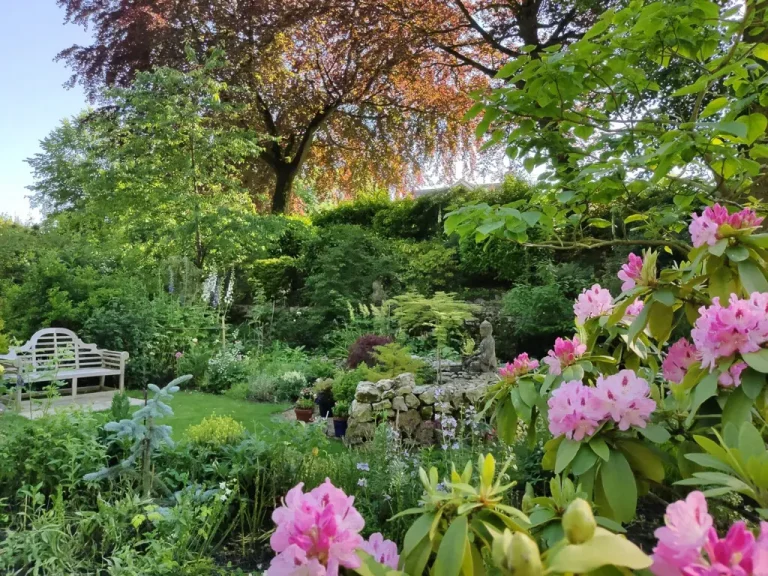
Prince Charles, in his forward of the book “Sacred Space” by Palmer and Manning, says
“the garden becomes a sanctuary… a paradise, a sacred space where humanity, nature and the divine meet in harmony”
The idea of creating our own “paradise garden” was popularised in modern times in this country by gardener Geoff Hamilton. He had the conviction that everyone could have their own special space to enjoy the tranquillity and beauty of nature – their own paradise garden. Of course, this had been a concept throughout history starting with the Garden of Eden in the Bible and Persian Gardens dating back 2,500 years.
Japanese Gardens
In 1996 I visited Japan to visit the Buddhist temples and gardens of Kyoto. Japanese gardens were a revelation to me, with their design being very deliberate – every element has spiritual symbolism. The aim of Japanese gardens is to copy nature and everything that is desirable in it. The design principles of a Japanese garden include asymmetry, enclosure, borrowed scenery and balance.
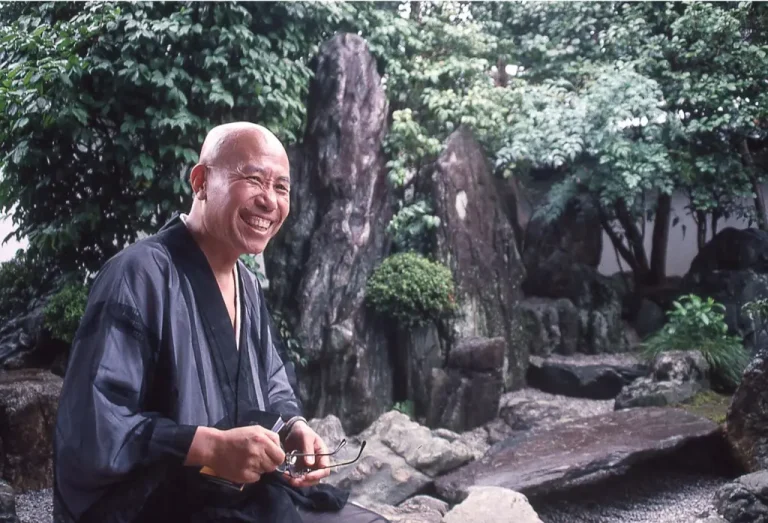
The more natural and harmonious the design, the more conducive it is to contemplation. Japanese gardens compel us to stay on the most natural path by trying to capture the essence of life.I discovered that there were several different types of Japanese gardens, not only those that try to imitate nature but also the dry gardens of shingle and rocks such as Daisen Inn at Daitoku-ji monastery and at Ryoan-ji.
This concept of gardening was introduced from China in the 12th century with the Rinzai school of Buddhism. The Japanese dry landscape Zen garden (karesansui) creates a miniature stylised landscape.
It consists of carefully composed arrangements of rocks, water, moss, pruned trees, bushes and raked gravel that represents ripples in water. These gardens often demonstrate oceans and mountains in miniature to remind us of the emptiness of our existence
Peace of mind – The tao
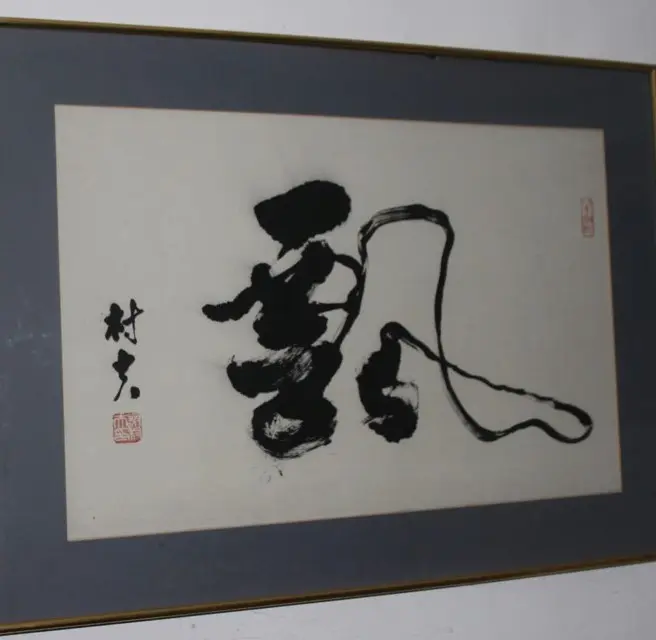
The Taoist view of our existence is that we are part of a fundamental unity that is nature, a continuous flow that is “the Way” or Tao. One translation of a Chinese character
depicting this was given to me many years ago by a dear friend. Translated, it is “How
graceful it is to bend with the wind like corn”. The picture has taken pride of place in my office and inspired me for 45 years!
The Yin and Yang principle in Chinese philosophy says that nature consists of 2 primordial forces that are opposites: dark/light, male/female, etc. The Tao is manifested in the interplay of these two forces in harmony, completing the circle of life.The philosophy of Taoism is not based on selfless persons but on persons fulfilled and completed by following “the Way”. We are not looking for deliverance from the present cycle of existence but discovering that this is the only true reality. By living in harmony with nature, we can lose the Buddhist idea of suffering. We can achieve a state like Nirvana – here and now. By perceiving the Tao, following “the Way” and being released from suffering (unfulfillment, frustration, dissatisfaction).
I believe it is this sense of harmony that gives us peace of mind when observing an
established natural garden or unspoilt landscape.

In 1996 I visited Eiheiji monastery in Japan to take instruction in Soto Zen meditation. Soto Zen Buddhism also seems to teach us not to try to go beyond what we are, but come to terms with what we are, to find our “Buddha Nature”. Not to try to change our state of mind but accept the one we are in. Accepting the moment as it is. Be open to the present. Let go. I was told that becoming “one with our nature” was the ultimate state of joy and beauty.
Realisation
When I was a child, I was told that God created the world and that if I put my trust in Him, He would show me the way. If I lived a good life with Christian values and believed that Christ was the son of God, I would go to Heaven. The first book I was given was Pilgrims Progress by John Bunyan, which inspired me and filled me with hope.
As I grew up, I discovered Buddhist philosophy and read the story of the Buddha. I was taught that if I followed the right path, I would gain wisdom and develop compassion for others, lose my suffering and selfish ego and thus discover the true nature of reality. I always thought that one day I would reach enlightenment and take my place in the God realm.

Buddhism also affirms that by losing our sense of Self, through meditation, we can experience that we have no independent inherent existence and experience the sense of Emptiness.
Now, at the age of 71, modern physics tells me that we are all part of the same infinite, interconnected and inter-dependant universe.
Everything is made of the same minute particles and that these are wavelike, moving randomly in an electro-magnetic energy field.
The Universe is a quantum vacuum that is filled with consciousness of which I am aware and relate closely to. Consciousness is the basis of reality and came before space and time. It is the ground of our Being, there was no creator.
It has taken me a lifetime to experience and understand all this. The delusions of God, Heaven, Nirvana and absolute values have gone. My ego is shattered and diminished, and unsurprisingly I have felt a huge sense of loss.
So many years taken up in life’s struggle for achievement, meaning and purpose, instead of just enjoying life.
Hopefully, I still have plenty of retirement years left to continue to study and follow the principles of Buddhism and the Tao. By feeling part of and going with Nature in a positive state of mind, I believe we can live a harmonious life and be happy. Suzuki said: “Our inner life is complete when it merges into Nature and becomes one with it. Through deep meditation we can lose our delusions and realise our true nature, find joy, peace and contentment”
My spiritual awakening has not turned out to be quite as I thought, but it is not a disappointment. I have finally seen that the universe is amazing, fantastic and wonderful.
What we perceive as nature is miraculous, and we should recognise this, be happy and celebrate our existence. The philosopher Spinosa said “know the physical, know the spiritual”.
Does the universe have a reason? Physics has made amazing discoveries about man and the universe in my lifetime, and scientific research and the resultant theories support much of what has been talked about for thousands of years by the different religions, particularly Buddhism, Hinduism and Taoism. Nevertheless, I don’t believe that scientists will ever be able to tell us the meaning of it all. Our own purpose and meaning remains a process of self-discovery and can be most rewarding if we try to reach the best of our abilities, to make the world a better place. To me, love and compassion also seem to be key.
At the end of his life, Father Bede Griffiths the Benedictine monk in his video “A Human Search” said he found that “going beyond the ego was peace and a sense of infinite beauty and love”.
Cascades Gardens – the meditation garden
Designing and creating my own meditation garden or sacred space, my own “Paradise”, I have been inspired by many other gardens, particularly gardens in Japan. Developing Cascades Gardens here in Derbyshire I have tried to follow the Buddhist principles of peace, stillness, harmony and respect for living things. It has been a spiritual journey and I have tried to work with Nature. Cascades Gardens is a natural garden following its original landscape of cliffs, woodland, streams and waterfalls. I believe that gardens are meant to be sat in, so at Cascades Gardens there are seats for relaxation and meditation to give one a feeling of wellbeing. Wherever you go in the garden, you can hear the soothing trickle of water. There are many places to be peaceful in natural secluded places and every opportunity to become immersed in and celebrate Nature.
Following the principles of Feng Shui, Cascades Gardens has a very positive energy flow. Feng Shui, the art of geomancy, is fundamental to a balanced Ying and Yang garden. The Chinese believe that a landscape is alive with forces that have to be taken into account when building anything including gardens. Every site has “Chi”, or energy, running through it. This universal energy flows through us and around us, creating our vitality and energising the potential of our surroundings. A free flow of energy promotes health, happiness, and a sense of wellbeing. A Danish lady visiting the garden recently said:
Beautiful and soothing with gifts for your eyes in every corner … and every sight shows you Nature is the great creator of harmony and balance
In April 2019, The Daily mail listed us as one of ten most inspiring spring gardens in Britain.
Gardening helps us to play our part in the cycle of cosmic harmony and balance. We are co-creators of the universe, our sacred responsibility and privilege. During the day, the huge cliffs at Cascades Gardens absorb the sunshine and radiate the energy back into the garden when the sun goes down. At twilight, this energy, heavy silence and stillness give the garden a deeply spiritual feeling.
The perfect place to meditate and be one with nature
One with nature
The garden at twilight, so vivid,
Alive, vibrant, outer worldly.
Three-dimensional, the garden talks to me,
Returning love.
Trees towering above limestone cliffs,
Dark against the sky.
Ancient yews rooted in water,
Profoundly still and peaceful.
Reflections of my Being,
Every plant stands proud.
Ruby leaves glowing,
We silently converse.
Enhanced state of mind;
Listening, touching, smelling,
Frogs croaking, water trickles by,
At last – one with nature.
(Alan Clements. Cascades Gardens at full moon
Summer Solstice 20th June 2019)